When Dr. Kirsten Frazier opened her practice in Simpsonville, South Carolina in 2021, the University of Iowa residency program graduate had two years of experience in a suburban Chicago orthodontic practice.
After utilizing traditional bonding as an associate and as a new practice owner, Dr. Frazier began seeking a new approach to “make treatment as efficient as possible for both the patients and for me. As a busy mom of two young children with a husband who works long hours in healthcare, I wanted to find a way to take care of my patients without being in the office more than necessary. I also wanted to make appointments as quick and easy for my patients as possible, and get them the best result as quickly as I could.”
Dr. Frazier had a strong team in place by the time she first tried a few digital indirect bonding cases in 2023. Pleased with the cases, she worked with her team to make DIB the bonding method for all patients in the practice being treated with braces.
“It was a learning curve, and we had some bond failures initially with our newer assistants, but they quickly got the hang of it,” she says. “I am lucky to have an incredible team. They were open to giving it a chance and worked hard to learn the system. Our vendor, KLOwen, came to the office and trained our team.”
The standardization of bracket positioning that DIB brings, whether bonding is done by a doctor or a team member, is important to Dr. Frazier. She has been happy with the accuracy of digital treatment planning for bonding, and with the efficiency of DIB.
“The accuracy of digital treatment planning for bonding is very high,” she says. “It has been really accurate for us.”
Dr. Frazier also notes that while the shorter appointment time for initial bonding is very helpful, the efficiency benefit also extends over the course of treatment.
“DIB allows us to do fewer repositioning appointments and space appointments out more,” she says. “We have a more efficient schedule, and it is great for patients as well. Everyone is busy and patients appreciate not needing to come into the office as often.”
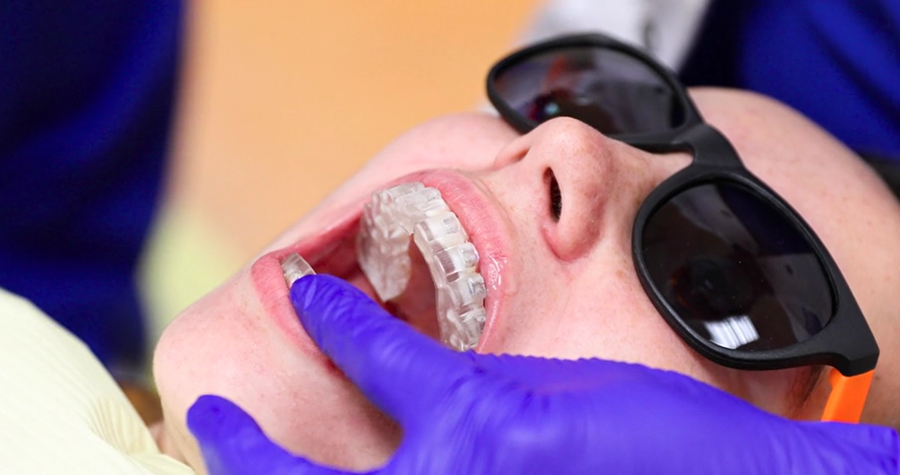
Dr. Lisa Alvetro of Sidney, Ohio, Chair of the AAO Council on Technology (CTech) became interested in digital indirect bonding as the technology came on the market, providing an alternative to the earlier analog method with stone models. Her positive experiences with the approach have led her to encourage colleagues using traditional bonding to consider switching to DIB.
“The digital process makes all the difference in the efficiency of the workflow from beginning to end,” says Dr. Alvetro. “The software for digital set-ups is now very intuitive and makes it easy to place brackets with precision to get each tooth to the desired position.”
Time required for bonding is reduced significantly for each case utilizing DIB.
“Once the patient is seated in the chair, their bonding time is reduced by about half,” says Dr. Alvetro. “It is easy to train staff to seat indirect bonding trays, or the doctor can do it. The process is completed by the chairside assistant curing the adhesive.”
Dr. Alvetro utilizes a 3D printer in her office for printing models for aligners and retainers, and also prints many DIB trays. Decision-making on tray production depends in part on what type of brackets will be used, based on the needs of the case and patient preferences such as esthetic brackets.
AAO Members and Teams Find a Wealth of DIB Educational Resources on TechSelect
Dr. Alvetro was instrumental in CTech’s development of the Digital Indirect Bonding and Custom Bracket Systems section of AAO member-exclusive TechSelect.
TechSelect DIB and custom bracket systems partner companies include DIBS AI, Brava Braces, Celebrace Custom Bracket, and Lightforce. The platform addresses 16 key questions about each product. It is easy to compare these products in TechSelect’s side-by-side format when considering DIB.
A section on evaluation criteria for DIB helps TechSelect users gain insight into how to select the DIB system that is the best fit for their practices. For example, some systems allow you to 3D print DIB trays, while others do not. Some systems allow for loading brackets yourself, while others come loaded by the supplier.
TechSelect has additional DIB resources including a step-by-step how-to guide for every part of the DIB workflow process, from selection through bonding, and a financial considerations overview.
Learn More: Annual Session CE
- The 2026 Annual Session will offer a lecture on DIB for orthodontic teams in the Clinical Techniques attendee path, on Friday May 1, beginning at 12:30 p.m. at the Orange County Convention Center in Orlando. Paul Gange Jr. will present “Chairside Direction for Digitally Guided Indirect Bonding.”
- Indirect bonding and virtual debonding will be addressed during an Innovation & Tech Talk lecture for doctors and teams by Dr. Tarek ElShebiny, “AI-Powered Solutions for Customized Orthodontic Treatment.” Dr. ElShebiny will present his lecture on Saturday, May 2 at 9 a.m.
View the Annual Session Lectures Program Grid
Learn More: Peer-Reviewed Publications
- Recently published research encompassing DIB includes an article in the AJO-DO Clinical Companion, “A Digital Customized Self-Ligating Orthodontic Bracket System,” (Xin Yang et al, articles in press, January 2026).
- In addition, an April 2023 study in the AJO-DO examined: “Accuracy of 3-Dimensional–Printed Customized Transfer Tray Using a Flash-Free Adhesive System in Digital Indirect Bonding: An in Vivo Study” (Gianluigi Fiorillo et al).