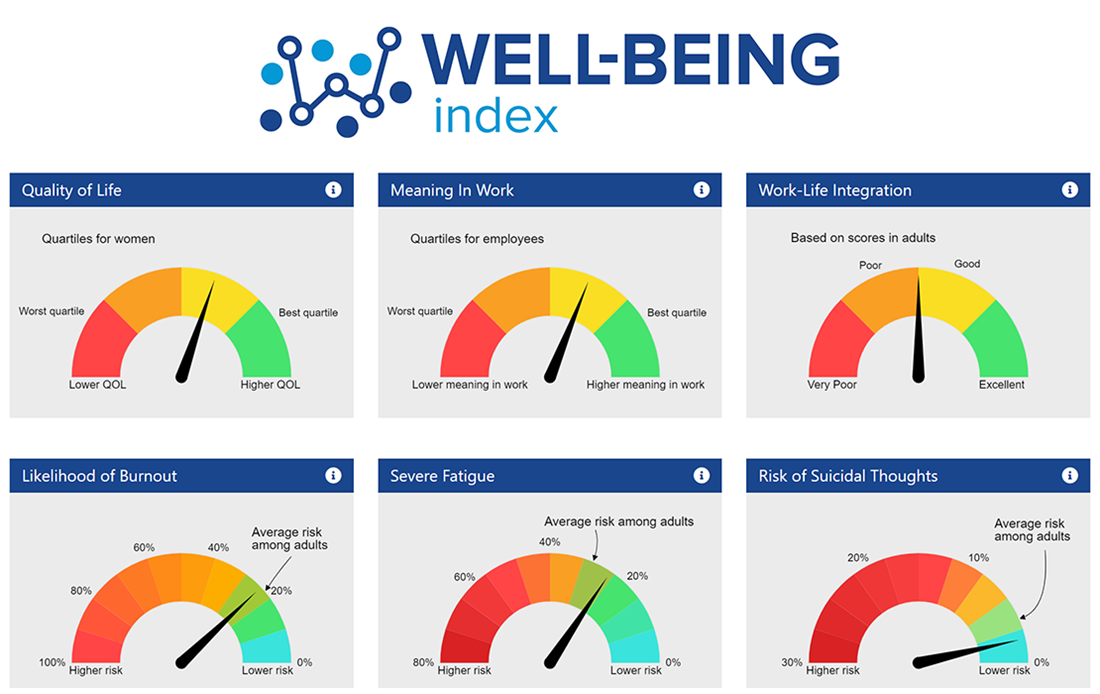
Six Dimensions of Distress and Well-Being

Why Distress and Well-Being Matter

Throughout the world, mental distress and well-being in the workplace is a topic of great concern. Orthodontists are no exception.

  • In a 2024 research study by AAO member, Dr. Soumya Padala, 27% of orthodontists are experiencing burnout and 21% are on the verge of burnout.
  • In a 2024 survey conducted by the AAO, 29% of AAO members rate their level of stress as High.

Poor mental health can negatively affect:

  • Job performance and productivity
  • Engagement in one’s work
  • Communication with team members and patients
  • Physical capability and daily functioning

In order to measure and combat psychological distress and promote well-being the Mayo Clinic developed and validated a 9-question Well-Being Index Assessment and identified 6 dimensions of distress and well-being. The AAO is able to provide the Well-Being Index for Dentists at no cost, courtesy of the ADA who licenses the Well-Being Index for Dentists to help all dentists, their staff and dental students regularly assess their well-being and access related resources. 

/

The Six Dimensions of Distress and Well-Being

Individuals who are not feeling fulfilled by their job duties are at a high risk of psychological distress. Those who can develop an honest connection to their work are far less likely to experience other dimensions of distress such as burnout.

Burnout is one of the leading dimensions of psychological distress. In fact, the World Health Organization recently classified burnout as an occupational phenomenon and a legitimate diagnosis, defining it as “a syndrome conceptualized as resulting from chronic workplace stress that has not been successfully managed.

Symptoms of burnout that you should be aware of include:

  • Exhaustion
  • Mistakes
  • Sickness
  • Depression
  • Irritability
  • Cynicism
  • Alcohol or substance abuse

Severe fatigue is more than simply feeling sleepy; it is a dimension of psychological distress that is characterized by severe exhaustion and is commonly related to depression. Common causes include lack of sleep, lack of physical activity, and unhealthy eating habits. Severe fatigue can also be the symptom of prolonged mental work or extended periods of stress and anxiety, and can be intensified by boring or repetitive tasks.

Common effects of fatigue include:

  • Decreased task motivation
  • Longer reaction time
  • Reduction of alertness
  • Impaired concentration
  • Poor psychometric coordination
  • Problems in memory and information processing
  • Poor judgment

Work-life integration can be defined as an approach that creates synergy between all areas that make up one’s life, including their career or profession, home and family, and community. Work-life integration has largely replaced the concept of work-life balance, as these areas of one’s life can rarely be separated. Rather than placing each aspect on a scale and attempting to determine if they are balanced, the work-life integration approach views life and work holistically. The measurement of this dimension aims to discover how successfully an individual is creating the optimal engagement, fulfillment, and well-being from their entire being. A healthy mix and integration between all aspects of one’s life has a profound impact on their state of psychological well-being.

Mental quality of life is an important dimension of both distress and well-being. The Well-Being Index identifies both a high or low mental quality of life in individuals as part of their overall well-being assessment. Factors in a participant’s personal and professional life play a role in measuring their quality of life.

Increased exposure to high-stress environments and situations will threaten the quality of life in individuals. The American Psychological Association states that workplace stressors have a significant impact on workers’ overall health. Stress experienced, as well as stress perceived, have been shown to negatively affect an individual’s psychological well-being.

Suicide is a serious public health issue and suicidal ideation is one of the most important dimensions of psychological distress to measure consistently. The Well-Being Index measures the risk of suicidal ideation in participants as part of their overall distress and well-being. The measurement of this dimension of mental distress is not an evaluation or diagnosis, but instead an assessment of the potential risk of suicidal thoughts if no changes are made to the individual’s well-being.

Some signs of suicidal ideation in the workplace include:

  • Isolation at work
  • Poor job performance
  • Sudden change in an employee’s personality
  • Previous suicide attempts or threats
  • Expressions of hopelessness or depression
  • Lack of interest in the job
  • Signs of other dimensions of distress such as burnout or fatigue

Mental Well-Being Index for Dentists

The interactive online tool allows dental professionals to anonymously measure their well-being in less than one minute, compare their scores to peers’ and national averages, and track their progress over time.

Features:

  • 100% Anonymous
  • 9 Questions
  • Evidenced-Based
  • 6 Dimensions, Not 1

In A Crisis?

Call or Text 998 or Chat @ 988lifeline.org. The 988 Suicide & Crisis Lifeline is a national network of local crisis centers that provides free and confidential emotional support to people in suicidal crisis or emotional distress 24 hours a day, 7 days a week.