Every orthodontist has fielded questions that point to a larger problem. Why should I see a specialist? Can my dentist provide the same treatment? Does my child really need an evaluation at age 7?
To members, the distinctions are familiar. To patients, they are not always clear. The challenge is to reach consumers with accurate information before they choose a provider. That is the purpose of the AAO’s Consumer Awareness Program (CAP).
CAP works to strengthen public understanding of orthodontists as specialists. It explains why advanced education and focused training matter, why an early evaluation can be valuable, and where families can turn for credible guidance. Without a coordinated national effort, those messages would compete practice by practice with online misinformation, non-specialist advertising, and whatever an algorithm happens to serve first.
Members recognize the stakes. In a recent AAO survey, 96.2% of respondents rated promoting orthodontists as specialists as an extremely or very important strategic objective. They also identified the growth of non-orthodontist providers and the use of AI and social media for health information among the leading trends affecting the specialty.
CAP addresses both concerns by placing orthodontist-developed information where consumers are already looking for answers. Its reach includes digital advertising, social media, traditional search, AI-powered search, and the AAO consumer website. Campaigns such as Straight Answers, Bright Smiles address common treatment questions in an approachable format, while Smiles at 7 Day gives parents a clear and memorable reason to consider an early evaluation.
“The conversation about specialist care is already happening online, whether we take part or not. I can educate the families who come into my practice, but I cannot educate an entire country. CAP gives every AAO member a voice in that larger conversation and tools to continue it locally.” – Dr. Jashleen Bedi, Chair, Council on Communications.
The results demonstrate what a collective effort can accomplish. Over the past year, CAP generated more than 1 billion consumer impressions and 23 million clicks. It brought 17.2 million visitors to the AAO’s consumer website, where they could research treatment and learn about care from an orthodontic specialist.
The program is also adapting as search behavior changes. AAO content appeared in more than 30,000 AI-generated search results last year, a 430% increase over the previous year. Consumers are increasingly turning to AI tools for health information; CAP helps ensure that orthodontist-developed guidance remains part of the answer.
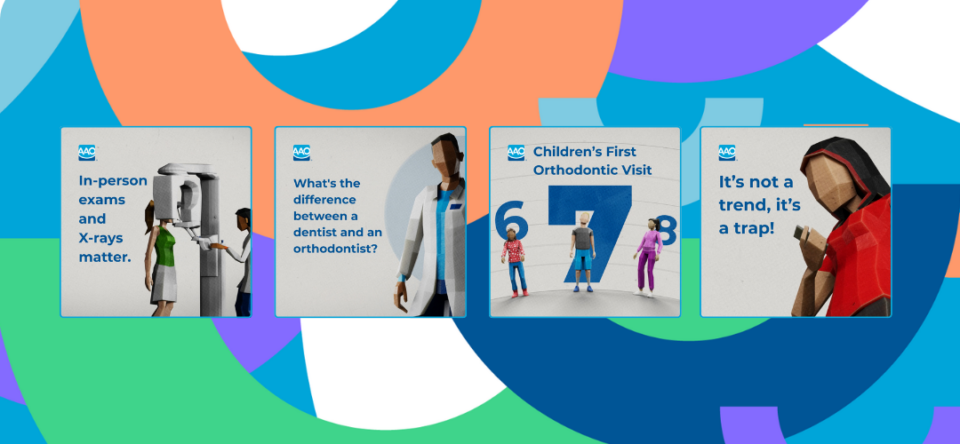
That national work does not replace local marketing; it gives members a stronger foundation for it. CAP provides ready-to-use videos, flyers, posters, handouts, social content, and referral tools. Members can promote age 7 evaluations, explain the difference between an orthodontist and a dentist, address questions about X-rays and DIY treatment, or respond to online trends such as mewing. Dentist referral resources support professional relationships, and Bullying Bites offers another way to engage young people and families.
These materials spare individual practices from having to research, write, and design every piece of consumer education themselves. They also create continuity. A family may encounter an AAO message online, see related information from a local practice, and hear the same guidance during an appointment.
If CAP disappeared, orthodontists would continue educating patients one conversation at a time. We would lose the sustained national presence that helps shape those conversations before they begin. No individual practice could maintain that level of public education on its own. Together, AAO members can.